Faithful to His call= Fruitful

Our blueberry bushes are amazing!

My first experience telling others about Jesus was traveling to various neighborhoods in Michigan’s Upper Peninsula where our church members lived, teaching 5-day clubs to children. It was the summer I turned 12 years old and I had trained through Child Evangelism Fellowship.

My second, third and fourth journeys were also in the summertime, two with Teen Missions, International and the last with New Tribes Mission. These trips took me to Oahu, HI; Palmer, AK; and the hollers of Kentucky with wonderful teams of Christian believers from all around the country.

After my husband and I were married, we went on a cross-cultural journey together. With our first daughter, who was still a baby, we headed to Europe and North Africa for a year with a multinational group of single adults and married couples. Our daughter was adored by many “aunties and uncles”.

Reading about Paul’s second missionary journey (see the passage below), I was caught up in the travel involved and the way he met with people whose hearts were being called by God.

The generosity they experienced was a result of hearts being changed. The churches supported Paul and Silas as well as young Timothy (Paul’s “trainee”). Along the way, the old and new converts opened their hearts and homes to the love that God showed them through His Son, Jesus Christ the Lord.

Those who were changed were also encouraged to remain faithful. Although the church of that day did not promote women leaders (due to lack of education), Lydia may have been an exception as she eventually opened up her home as the hub for the growing church. #Philippians

Philippi was a great trade city in the province of Macedonia where Paul and his partners were “called” to minister. Lydia was a wealthy business owner involved in trading purple cloth there and her heart was touched by the gospel message as Paul preached the good news. She was used by God because she recognized in herself the desire to be faithful to Him and left it up to Paul to judge her authenticity and accept her generosity.

My prayer is to always be faithful wherever God leads me. His grace through me is sufficient even for the difficult tasks that seem too much. (I’ve been quoting Paul’s words all this week, 2 Corinthians 12:9, “My grace is sufficient for thee, for my strength is made perfect in weakness.”). -Teresa #faithful #fruithatwillast

Acts 16:11-15 (ESV)

The Conversion of Lydia

11 So, setting sail from Troas, we made a direct voyage to Samothrace, and the following day to Neapolis, 12 and from there to Philippi, which is a leading city of the[d] district of Macedonia and a Roman colony. We remained in this city some days.13 And on the Sabbath day we went outside the gate to the riverside, where we supposed there was a place of prayer, and we sat down and spoke to the women who had come together. 14 One who heard us was a woman named Lydia, from the city of Thyatira, a seller of purple goods, who was a worshiper of God. The Lord opened her heart to pay attention to what was said by Paul. 15 And after she was baptized, and her household as well, she urged us, saying, “If you have judged me to be faithful to the Lord, come to my house and stay.” And she prevailed upon us.

Also…Please enjoy this informative paper (below), I found it on Regent University, http://www.regent.edu site (see this excerpt from “Lydia’s Story” written by Peter Foxwell) :

“Peter Foxwell serves as the lead pastor of the Cornerstone Church of Clyde, MI (www.FamousGod.com). He is also a student in the Doctor of Education in Christian Leadership program at Liberty University. “

“Lydia’s Story”

“THE ROMAN COLONY OF PHILIPPI”

“Lydia was the first convert to the Christian faith in the colonial Roman city of Philippi (Acts 16:11-15), located in the district of Macedonia. In that Roman administrative region, Thessalonica was larger, and Amphipolis was the capital; nevertheless, Philippi is described as a leading or principal city (Bock, 2007), perhaps because it was considered a crossroads between Europe and Asia (Calpino, 2012).”

“Philippi was administered according to the laws and constitution of the city of Rome (Bruce, 1980) and enjoyed the highest status a provincial town could have (Bock, 2007). All in all, it would have felt very Roman. The city’s religious life followed the imperial cult and was a center for the worship of a variety of gods.”

“THE JEWISH PLACE OF PRAYER IN PHILIPPI”

“Paul’s missionary strategy included visiting local synagogues (cf., Acts 13:14; 14:1; 17:1), but there was no synagogue in Philippi, perhaps due to a lack of Jewish men there (Bruce, 1980). However, there was an informal place of prayer (Gk. proseuchen, sometimes means a synagogue, but not in this case, Bruce, 1980) attended, it seems, exclusively by women (Acts 16:13). Among the worshippers was Lydia, a dealer in purple cloth.”

“LYDIA, A WOMAN OF STATUS”

“Lydia was from the city of Thyatira, located in Asia Minor in the region known as Lydia (Peterson, 2009). It was known for its “purple dye and textiles” (p. 460). Possibly Lydia sold cloth to wealthy clients in Philippi, and she should be considered a woman of status (Bock, 2007). Inscriptional evidence recovered from Philippi demonstrates that women undertook many leadership roles, such as offices in various religions (Calpino, 2012). They also paid for public works, such as statues on which they inscribed their names and status.”

“In the first-century Roman world, women owned and managed businesses, both large and small (Calpino, 2012). Mowczko (2018) notes that members of the senatorial (aristocratic) class were independently wealthy and did not engage in business, but members of the wealthy equestrian class did run businesses. Lydia sold a luxury item that would have required access to significant capital investment, which means she belonged to the equestrian class’s provincial equivalent, or she was “a relatively wealthy commoner” (p. 4). Lydia was very likely an independent business owner since women occupied “a prominent place in Macedonian life” (Fee, 1995, p. 27).”

“THE CONVERSION OF LYDIA”

“When Paul first met Lydia, she was a “worshipper of God” or a God-fearer (Acts 16:14). Her Greek background would suggest that Lydia was a former polytheist.”

“Now, she was “believing and behaving as a Jew without having become one” (Stott, 1990, p. 263). When Paul spoke, the Lord worked through his message to open her heart to believe in Jesus (Acts 16:14). Stott remarks that “the message was Paul’s, the saving initiative was God’s (p. 263). Acts 16:15 mentions her conversion to the Christian faith. There, she claims to be a true believer in the Lord, and she and her household were baptized. She then persuades Paul and his companions to stay at her home. Paul and his entourage remain based at Lydia’s house for the duration of their ministry in Philippi. The infant church also gathers there (Acts 16:40).”

“LYDIA’S HOME AND HOUSEHOLD”

“Details about Lydia’s marital status and home life are scarce (Barnes, 1995). We do not know if she was married, single, divorced, or widowed. However, it is possible to glean some helpful insights from the biblical text. Notably, the author of Acts does not associate Lydia with a man. In ancient Roman culture, women were known through their men (Barnes, 1995). Luke may be communicating “that the God of the Gospel is not interested in traditional social barriers of this world, particularly those associated with the pivotal value, honor/shame” (p. 181).”

“In Acts 16:15, the word translated household and home is the same Greek term, oikos. It does not refer to a building but an extended family under Lydia’s leadership and care. Spouses, children, household servants/slaves, laborers, even business associates, and tenants were considered members of an ancient Roman household (Towner, 1993). The house was held together through a bond based on “common economic, social, psychological, and religious factors” (p. 417). Belonging to the household gave its members “a sense of security and identity” (p. 417). Lydia’s offer to accommodate and support Paul and his companions within her household, “suggests she owned a villa” (Fee, 1995, p. 26).”

“The head of the household had authority over its members and a duty to care for them. Lydia may have been the head (Latin, domina) of her house either because she was a widower, divorcee, or a single woman of means (Peterson, 2009). She demonstrates her authority by leading its members in Christian baptism, offering hospitality to Paul and his ministry team in her home, and making her home available as their base of operations and as a gathering place for the church (Calpino, 2012). In this way, Paul and his team, as well as the church, came under her protection (p. 285).”

“CONCLUSION”

“Lydia was likely an independent woman, the head of her household, and the owner of a business requiring significant capital. How, then, would these qualities have translated into the Christian community in Philippi? Osiek (2009) suggests that women took part in all the ministries of the house church. Is this likely? The answer may lie in the customs and practices of first-century Roman society.”…’ (see more on Regent University website)

Author(s): Peter Foxwell  

Journal: Journal of Biblical Perspectives in Leadership

Issue: 1  

Volume: 10  

Year: 2020

First, the people were silent (unsure), then the people fell on their faces (certain of whom they trusted)!!

Hyatt House in Rochester (secret patio)

On my last visit to see mom, I was rewarded with some Vitamin D after “finding” the secret patio at the hotel. the sky was glorious (although a bit hazy from the Canadian fires) with just small puffs of clouds suspended in air.

In this passage, Elijah had a “show-down” with the prophets of Ba’al, he was watching intently for a cloud. The small puff of a cloud was his sign that the famine had ended in Israel. It was Elijah’s confirmation that the years of waiting were over.

Elijah gathered up his garments and ran. He ran like no other racer has ever run. He ran in the rain from the top of Mount Carmel to Jezreel. He ran ahead of King Ahab’s chariot. He ran because the hand of the Lord was on him.

This “show-down” was also from God’s hand. It included Elijah challenging the idol called Ba’al, the fire falling from heaven in answer to Elijah’s prayer, the actions/words of the people choosing God and not fearfully “limp (ing) around” with falsehood any longer. It ended with the slaughter of the false prophets who were deceiving God’s people. Watching Elijah run before him (for 25 miles), Ahab even had a chance to repent from allowing his wife, Jezebel, rule him and the country when she frightened everyone into submission by slaughtering God’s prophets. Afterwards, Elijah ran for his life as Jezebel threatened him as well.

God’s hand was evident in Elijah’s lifetime. Even today, people who live in oppressed situations, waiting for deliverance are waiting for the evidence of God. Yet, our waiting is over once we look heavenward and remember who is truly God. It is not those who threaten and wield fear as a weapon. It is the Creator of the clouds who shows the sign of His intention for mankind.

The greatest sign of all is the rainbow, given to Noah in a covenant to never wipe out mankind again. Noah and his family were saved because they found grace in the eyes of the Lord.

We too can find grace in the eyes of the Lord when we receive Jesus Christ as Lord of our lives (John 1:12,17).

This is called good news or the gospel message. Just as Elijah spotted the sign of a small puff of cloud, he was assured that his waiting was over.

Your “secret patio” may look a bit different than mine or the sign God gives you may not be a small puff of cloud, but the reward of waiting for God’s grace to appear in your family and loved ones will be worth the investment of time spent.

We also can rejoice in God’s glorious plan to bring grace to every people, tribe, tongue and nation. The sign of God’s grace for mankind is the empty tomb. Nothing has the power to stop God’s love for us, not even death.- Teresa

I Kings 18: 20-46 (ESV)*

The Prophets of Baal Defeated

20 So Ahab sent to all the people of Israel and gathered the prophets together at Mount Carmel.21 And Elijah came near to all the people and said, “How long will you go limping between two different opinions? If the Lord is God, follow him; but if Baal, then follow him.” And the people did not answer him a word. 22 Then Elijah said to the people, “I, even I only, am left a prophet of the Lord, but Baal’s prophets are 450 men. 23 Let two bulls be given to us, and let them choose one bull for themselves and cut it in pieces and lay it on the wood, but put no fire to it. And I will prepare the other bull and lay it on the wood and put no fire to it. 24 And you call upon the name of your god, and I will call upon the name of the Lord, and the God who answers by fire, he is God.” And all the people answered, “It is well spoken.” 25 Then Elijah said to the prophets of Baal, “Choose for yourselves one bull and prepare it first, for you are many, and call upon the name of your god, but put no fire to it.” 26 And they took the bull that was given them, and they prepared it and called upon the name of Baal from morning until noon, saying, “O Baal, answer us!” But there was no voice, and no one answered. And they limped around the altar that they had made. 27 And at noon Elijah mocked them, saying, “Cry aloud, for he is a god. Either he is musing, or he is relieving himself, or he is on a journey, or perhaps he is asleep and must be awakened.” 28 And they cried aloud and cut themselves after their custom with swords and lances, until the blood gushed out upon them.29 And as midday passed, they raved on until the time of the offering of the oblation, but there was no voice. No one answered; no one paid attention.

30 Then Elijah said to all the people, “Come near to me.” And all the people came near to him. And he repaired the altar of the Lord that had been thrown down. 31 Elijah took twelve stones, according to the number of the tribes of the sons of Jacob, to whom the word of the Lord came, saying, “Israel shall be your name,” 32 and with the stones he built an altar in the name of the Lord. And he made a trench about the altar, as great as would contain two seahs[a] of seed. 33 And he put the wood in order and cut the bull in pieces and laid it on the wood. And he said, “Fill four jars with water and pour it on the burnt offering and on the wood.” 34 And he said, “Do it a second time.” And they did it a second time. And he said, “Do it a third time.” And they did it a third time. 35 And the water ran around the altar and filled the trench also with water.

36 And at the time of the offering of the oblation, Elijah the prophet came near and said, “O Lord, God of Abraham, Isaac, and Israel, let it be known this day that you are God in Israel, and that I am your servant, and that I have done all these things at your word. 37 Answer me, O Lord, answer me, that this people may know that you, O Lord, are God, and that you have turned their hearts back.”38 Then the fire of the Lord fell and consumed the burnt offering and the wood and the stones and the dust, and licked up the water that was in the trench.39 And when all the people saw it, they fell on their faces and said, “The Lord, he is God; the Lord, he is God.” 40 And Elijah said to them, “Seize the prophets of Baal; let not one of them escape.” And they seized them. And Elijah brought them down to the brook Kishon and slaughtered them there.

The Lord Sends Rain

41 And Elijah said to Ahab, “Go up, eat and drink, for there is a sound of the rushing of rain.” 42 So Ahab went up to eat and to drink. And Elijah went up to the top of Mount Carmel. And he bowed himself down on the earth and put his face between his knees. 43 And he said to his servant, “Go up now, look toward the sea.” And he went up and looked and said, “There is nothing.” And he said, “Go again,” seven times. 44 And at the seventh time he said, “Behold, a little cloud like a man’s hand is rising from the sea.” And he said, “Go up, say to Ahab, ‘Prepare your chariot and go down, lest the rain stop you.’” 45 And in a little while the heavens grew black with clouds and wind, and there was a great rain. And Ahab rode and went to Jezreel.46 And the hand of the Lord was on Elijah, and he gathered up his garment and ran before Ahab to the entrance of Jezreel.Read full chapter

Footnotes

  1. 1 Kings 18:32 A seah was about 7 quarts or 7.3 liters

*Oneyearbibleonline.com

Your children’s children

Swinging with the grandkids

God’s blessing (as described in this Psalm) meant fruitful labor, children and grandchildren. It also meant a prosperous nation.

It is not wrong to assume that having peace or absence of war was an additional blessing from the God of Israel in that day.

Fear of the Lord meant reverence for Him and His word. Today, we also have an obligation to fear the Lord. The “blessing”, however, that results will not necessarily be peace from earthly war but peace with God.

We are no longer under a Suzerain-vassal treaty as the nation of Israel had with YHWH but under the new covenant agreement based on God’s promise for the anointed One (aka the Messiah or the Christ). (See Jeremiah 31)

This covenant was fulfilled when Jesus Christ the Lord took on the sins of the world. He is the Father’s way to provide redemption from sin for mankind plus to fulfill the Father’s desire to include those from every tribe, tongue, people and nation into His kingdom.

As much as I love my grandchildren, I am even more grateful for Jesus Christ, my Savior. He is my blessing. He blessed me by making peace with God on my behalf.

I can pass this great blessing on to my children and grandchildren. – Teresa #legacyofpeace

Psalm 128:1-6 (ESV) *

Blessed Is Everyone Who Fears the Lord

A Song of Ascents.

128 Blessed is everyone who fears the Lord,
who walks in his ways!
2 You shall eat the fruit of the labor of your hands;
you shall be blessed, and it shall be well with you.

3 Your wife will be like a fruitful vine
within your house;
your children will be like olive shoots
around your table.
4 Behold, thus shall the man be blessed
who fears the Lord.

5 The Lord bless you from Zion!
May you see the prosperity of Jerusalem
all the days of your life!
6 May you see your children’s children!
Peace be upon Israel!

*Oneyearbibleonline

Jeremiah 31:31-34 “Indeed, a time is coming,” says the Lord, “when I will make a new covenant with the people of Israel and Judah.32 It will not be like the old covenant that I made with their ancestors when I delivered them from Egypt. For they violated that covenant, even though I was like a faithful husband to them,” says the Lord.33“But I will make a new covenant with the whole nation of Israel after I plant them back in the land,” says the Lord. “I will put my law within them and write it on their hearts and minds. I will be their God and they will be my people.34
“People will no longer need to teach their neighbors and relatives to know me. For all of them, from the least important to the most important, will know me,” says the Lord. “For I will forgive their sin and will no longer call to mind the wrong they have done.”

Word picture

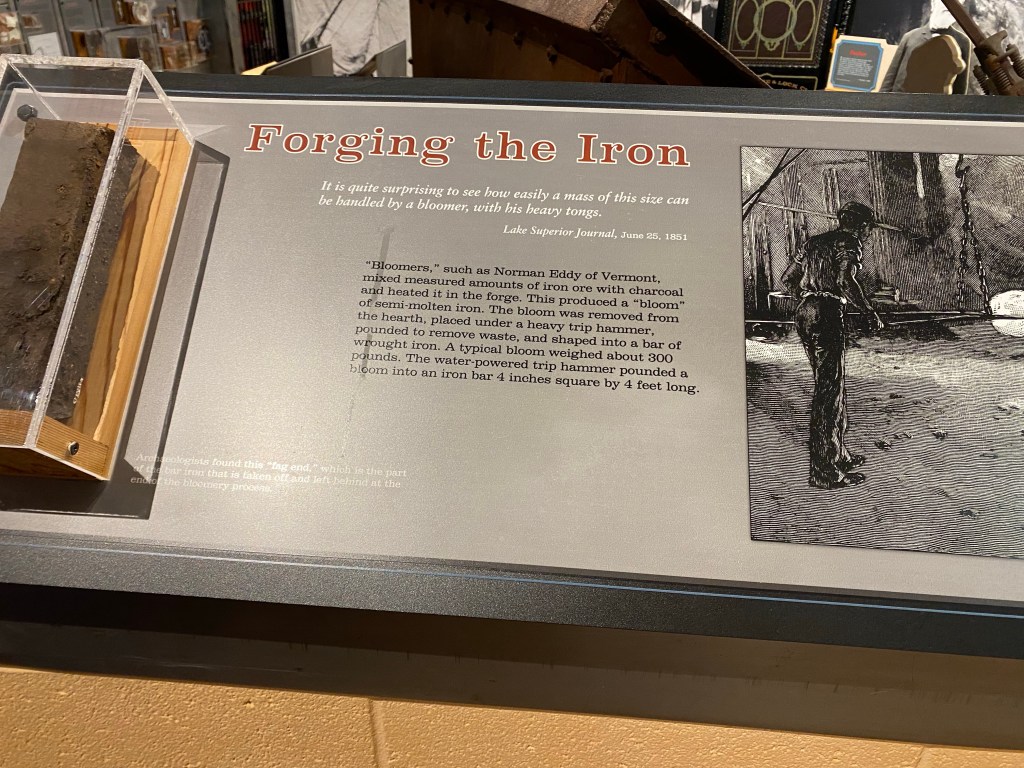
Iron Industry Museum, Negaunee, MI

On the last visit I made to my hometown, I visited the Iron Industry Museum. My father and grandfather made their living through this industry. The state of MI and Ford Motor Company were supported for many years through these rich iron ore deposits in the Upper Peninsula.

The words on each exhibit along with the pictures, effectively told the story. Whether the words painted the picture or the picture was worth 1,000 words, I enjoyed the value of communicating this history through word pictures.

In this Psalm, I see an Old Testament word picture or poem. The words were historically recited by the people of Israel on the way to Jerusalem each year (for their three mandatory feast observations).

Rather than trusting man-made idols visible on “the hills” around Jerusalem, the Psalmist called out the truth of God (YHWH) as the creator of heaven and earth.

Even today, we should remember it is not what WE create out of iron or steel that makes us prosper but what God has created in us- a hope and a future.

The Lord “kept” the children of Israel and will “keep” us. What does He keep us from? We are kept from ALL harm when we trust Him.

The harm may include deadly physical elements of heat and sun exposure or nighttime predators. It could also be a spiritual degradation found in today’s culture to remove a life from the earth before their time (aka abortion).

Our coming and going will be kept by God when our eyes look to Him.- Teresa #keeplifesacred

Psalm 121 (ESV) *

A Song of Ascents.

121 I lift up my eyes to the hills.
From where does my help come?
2 My help comes from the Lord,
who made heaven and earth.

3 He will not let your foot be moved;
he who keeps you will not slumber.
4 Behold, he who keeps Israel
will neither slumber nor sleep.

5 The Lord is your keeper;
the Lord is your shade on your right hand.
6 The sun shall not strike you by day,
nor the moon by night.

7 The Lord will keep you from all evil;
he will keep your life.
8 The Lord will keep
your going out and your coming in
from this time forth and forevermore.

*OneYearBibleOnlinehttps://biblegateway.comESV