Humility is not easy. Especially when I feel robbed. For example, as a “builder”, I take great joy in planning, implementing and seeing the final product emerge. Not until the chimney is on am I deeply satisfied!
Have you ever met someone who sees the benefit of your plan? Only after the messy work of digging the foundation and putting in the plumbing, will they step up and even bully themselves into the place of “foreman” and take over the final steps.
In my humbling experience, not only did my idea become “used” by another but the satisfaction of finishing it was thwarted. Not so with Solomon. He had a father (King David) who planned and prepped for him to finish the building of God’s house, the Temple. It was all done as David planned and Solomon was the “foreman” who stepped in and gave glory to God, after following David’s instructions.
God saw Solomon’s humility and answered his prayer by coming down with great power and glory into the finished product. Lord, we pray for your kingdom come and your will be done on earth as it is in heaven.
Whether it’s an abrupt change of plans or truly having your hard work robbed, I propose that by humbling ourselves before God we will be vessels of clay for God’s glory to descend upon.-Teresa
2 Chronicles 7: 11-18 ESV *
11 Thus Solomon finished the house of the Lord and the king’s house. All that Solomon had planned to do in the house of the Lord and in his own house he successfully accomplished. 12 Then the Lord appeared to Solomon in the night and said to him: “I have heard your prayer and have chosen this place for myself as a house of sacrifice. 13 When I shut up the heavens so that there is no rain, or command the locust to devour the land, or send pestilence among my people, 14 if my people who are called by my name humble themselves, and pray and seek my face and turn from their wicked ways, then I will hear from heaven and will forgive their sin and heal their land. 15 Now my eyes will be open and my ears attentive to the prayer that is made in this place.16 For now I have chosen and consecrated this house that my name may be there forever. My eyes and my heart will be there for all time. 17 And as for you, if you will walk before me as David your father walked, doing according to all that I have commanded you and keeping my statutes and my rules, 18 then I will establish your royal throne, as I covenanted with David your father, saying, ‘You shall not lack a man to rule Israel.’
Please enjoy this post from 2015 (with a few edits). Remember…being hidden in Christ is a beautiful thing. I watched my grandkids this week “hide” in an opaque “Paw Patrol” pop-up tent. They were sure I couldn’t see their adorable selves. They told me it was a lion, a pig, a bear making the tent crash around. God’s heart desires fellowship with us, we must just be honest about our need of Him. He will provide the rest.
When David was terrified by the presence of the angel of the Lord, he repented at the threshing floor of Araunah the Jebusite and God had mercy on the people.
This was the same place where many years earlier, Abraham willingly offered up in obedience his son, Isaac, who was then a young man. God saw Abraham’s heart of faith and stopped Him, by “providing a lamb” for the sacrifice (see Genesis 22:8).
Even so, this place of extreme repentance became the site of Solomon’s ornate temple, built for worshiping the God above all gods. Solomon had the wisdom and skills to make a profoundly intricate work, majestic enough to cause the glory of God to descend on it in a cloud (see 2 Chronicles 5:14).
Even today, we repent and worship at this site as it is also the mountain called Calvary where Jesus, the lamb of God, gave himself up for the sins of the world. This place of repentance, is where we picture our head being dripped on by the blood of Christ Jesus our Lord. He substituted His righteousness for my sinfulness as He provided atonement for me.
Lord, you terrify us with your presence because you are so holy. Purify us by the blood of your Son and our Savior so that we may worship You in Spirit and in truth. We rejoice because of your provision for us. -Teresa #hiddenbutfullyseen
Genesis 22:1-14 (NET) (bold added)
1Some time after these things God tested Abraham. He said to him, “Abraham!” “Here I am!” Abraham replied.2 God said, “Take your son – your only son, whom you love, Isaac – and go to the land of Moriah! Offer him up there as a burnt offering on one of the mountains which I will indicate to you.”3 Early in the morning Abraham got up and saddled his donkey. He took two of his young servants with him, along with his son Isaac. When he had cut the wood for the burnt offering, he started out for the place God had spoken to him about.4 On the third day Abraham caught sight of the place in the distance.5 So he said to his servants, “You two stay here with the donkey while the boy and I go up there. We will worship and then return to you.”6 Abraham took the wood for the burnt offering and put it on his son Isaac. Then he took the fire and the knife in his hand, and the two of them walked on together.7Isaac said to his father Abraham, “My father?” “What is it, my son?” he replied. “Here is the fire and the wood,” Isaac said, “but where is the lamb for the burnt offering?”8 “God will provide for himself the lamb for the burnt offering, my son,” Abraham replied. The two of them continued on together.9 When they came to the place God had told him about, Abraham built the altar there and arranged the wood on it. Next he tied up his son Isaac and placed him on the altar on top of the wood.10 Then Abraham reached out his hand, took the knife, and prepared to slaughter his son.11 But the Lord’s angel called to him from heaven, “Abraham! Abraham!” “Here I am!” he answered.12 “Do not harm the boy!” the angel said. “Do not do anything to him, for now I know that you fear God because you did not withhold your son, your only son, from me.”13 Abraham looked up and saw behind him a ram caught in the bushes by its horns. So he went over and got the ram and offered it up as a burnt offering instead of his son.14 And Abraham called the name of that place “The Lord provides.” It is said to this day, “In the mountain of the Lord provision will be made.”
1 Chronicles 21: 18-30 22:1-6 (ESV) (bold added)
David Builds an Altar
18 Now the angel of the Lord had commanded Gad to say to David that David should go up and raise an altar to the Lord on the threshing floor of Ornan the Jebusite. 19 So David went up at Gad’s word, which he had spoken in the name of the Lord. 20 Now Ornan was threshing wheat. He turned and saw the angel, and his four sons who were with him hid themselves. 21 As David came to Ornan, Ornan looked and saw David and went out from the threshing floor and paid homage to David with his face to the ground. 22 And David said to Ornan, “Give me the site of the threshing floor that I may build on it an altar to the Lord—give it to me at its full price—that the plague may be averted from the people.” 23 Then Ornan said to David, “Take it, and let my lord the king do what seems good to him. See, I give the oxen for burnt offerings and the threshing sledges for the wood and the wheat for a grain offering; I give it all.” 24 But King David said to Ornan, “No, but I will buy them for the full price. I will not take for the Lord what is yours, nor offer burnt offerings that cost me nothing.” 25 So David paid Ornan 600 shekels[f] of gold by weight for the site. 26 And David built there an altar to the Lord and presented burnt offerings and peace offerings and called on the Lord, and the Lord[g] answered him with fire from heaven upon the altar of burnt offering. 27 Then the Lord commanded the angel, and he put his sword back into its sheath.
28 At that time, when David saw that the Lord had answered him at the threshing floor of Ornan the Jebusite, he sacrificed there. 29 For the tabernacle of the Lord, which Moses had made in the wilderness, and the altar of burnt offering were at that time in the high place at Gibeon, 30 but David could not go before it to inquire of God, for he was afraid of the sword of the angel of the Lord.
22 Then David said, “Here shall be the house of the Lord God and here the altar of burnt offering for Israel.”
David Prepares for Temple Building
2 David commanded to gather together the resident aliens who were in the land of Israel, and he set stonecutters to prepare dressed stones for building the house of God. 3 David also provided great quantities of iron for nails for the doors of the gates and for clamps, as well as bronze in quantities beyond weighing, 4 and cedar timbers without number, for the Sidonians and Tyrians brought great quantities of cedar to David. 5 For David said, “Solomon my son is young and inexperienced, and the house that is to be built for the Lord must be exceedingly magnificent, of fame and glory throughout all lands. I will therefore make preparation for it.” So David provided materials in great quantity before his death.
Solomon Charged to Build the Temple
6 Then he called for Solomon his son and charged him to build a house for the Lord, the God of Israel.7 David said to Solomon, “My son, I had it in my heart to build a house to the name of the Lord my God. 8 But the word of the Lord came to me, saying, ‘You have shed much blood and have waged great wars. You shall not build a house to my name, because you have shed so much blood before me on the earth. 9 Behold, a son shall be born to you who shall be a man of rest. I will give him rest from all his surrounding enemies. For his name shall be Solomon, and I will give peace and quiet to Israel in his days. 10 He shall build a house for my name. He shall be my son, and I will be his father, and I will establish his royal throne in Israel forever.’
2 Chronicles 3: 1-3 (NLT) bold added 3 So Solomon began to build the Temple of the Lord in Jerusalem on Mount Moriah, where the Lord had appeared to David, his father. The Temple was built on the threshing floor of Araunah[s] the Jebusite, the site that David had selected. 2 The construction began in midspring,[t] during the fourth year of Solomon’s reign.
John 19:16b-37 (NET) (first bold added)
So they took Jesus, 17 and carrying his own cross he went out to the place called “The Place of the Skull” (called in Aramaic Golgotha). 18 There they crucified him along with two others, one on each side, with Jesus in the middle. 19 Pilate also had a notice written and fastened to the cross, which read: “Jesus the Nazarene, the king of the Jews.” 20 Thus many of the Jewish residents of Jerusalem read this notice, because the place where Jesus was crucified was near the city, and the notice was written in Aramaic, Latin, and Greek. 21 Then the chief priests of the Jews said to Pilate, “Do not write, ‘The king of the Jews,’ but rather, ‘This man said, I am king of the Jews.’” 22 Pilate answered, “What I have written, I have written.” 23 Now when the soldiers crucified Jesus, they took his clothes and made four shares, one for each soldier, and the tunic remained. (Now the tunic was seamless, woven from top to bottom as a single piece.) 24 So the soldiers said to one another, “Let’s not tear it, but throw dice to see who will get it.” This took place to fulfill the scripture that says, “They divided my garments among them, and for my clothing they threw dice.” So the soldiers did these things. 25 Now standing beside Jesus’ cross were his mother, his mother’s sister, Mary the wife of Clopas, and Mary Magdalene. 26 So when Jesus saw his mother and the disciple whom he loved standing there, he said to his mother, “Woman, look, here is your son!” 27 He then said to his disciple, “Look, here is your mother!” From that very time the disciple took her into his own home.28 Jesus’ Death After this Jesus, realizing that by this time everything was completed, said (in order to fulfill the scripture), “I am thirsty!” 29 A jar full of sour wine was there, so they put a sponge soaked in sour wine on a branch of hyssop and lifted it to his mouth. 30 When he had received the sour wine, Jesus said, “It is completed!” Then he bowed his head and gave up his spirit. 31 Then, because it was the day of preparation, so that the bodies should not stay on the crosses on the Sabbath (for that Sabbath was an especially important one), the Jewish leaders asked Pilate to have the victims’ legs broken and the bodies taken down. 32 So the soldiers came and broke the legs of the two men who had been crucified with Jesus, first the one and then the other. 33But when they came to Jesus and saw that he was already dead, they did not break his legs. 34 But one of the soldiers pierced his side with a spear, and blood and water flowed out immediately. 35 And the person who saw it has testified (and his testimony is true, and he knows that he is telling the truth), so that you also may believe. 36 For these things happened so that the scripture would be fulfilled, “Not a bone of his will be broken.” 37 And again another scripture says, “They will look on the one whom they have pierced.”
When Governor PorciusFestus accused the Apostle Paul of being out of his mind from all his learning, Paul was not offended but addressed him as “most excellent Festus”.
King Herod Agrippa II was invited by Festus to hear Paul’s case. Agrippa understood the complex political climate of that region. But it was Paul’s words under the inspiration of the Holy Spirit, which delivered truth with convincing power. #almostpersuaded
If being out of my mind from too much learning means restoring God’s perspective, then I am fully persuaded to embrace Paul’s example and also witness about Jesus Christ the Lord, (v. 18) “to open their eyes, so that they may turn from darkness to light and from the power of Satan to God, that they may receive forgiveness of sins and a place among those who are sanctified by faith in me” (Jesus).
I am grateful for the great portion of the New Testament penned by the Apostle Paul while he was under house arrest in Rome. Because of this, I am persuaded that nothing can separate us from God’s love (Romans 8:39)- God loved and inspired Paul’s words to us. When the great mind of Paul was used to bring the simple gospel message to those in his company (guards, governors, kings, and now to us), I am inspired to also be a witness throughout the challenges of circumstantial suffering.
I may not be under lock and key, but there are pokes and jabs from those who purport friendship but do not hesitate to slander/spread untruths.
By yielding our perspective to God’s love, we can restore our mind. His purpose is amazingly intertwined with our heart, soul, mind and strength (Deut 6:5).
The Essence of the Covenant Principles Listen, Israel: The Lord is our God, the Lord is one!5You must love the Lord your God with your whole mind, your whole being, and all your strength.
26 So Agrippa said to Paul, “You have permission to speak for yourself.” Then Paul stretched out his hand and made his defense:
2 “I consider myself fortunate that it is before you, King Agrippa, I am going to make my defense today against all the accusations of the Jews, 3 especially because you are familiar with all the customs and controversies of the Jews. Therefore I beg you to listen to me patiently.
4 “My manner of life from my youth, spent from the beginning among my own nation and in Jerusalem, is known by all the Jews. 5 They have known for a long time, if they are willing to testify, that according to the strictest party of our religion I have lived as a Pharisee. 6 And now I stand here on trial because of my hope in the promise made by God to our fathers, 7 to which our twelve tribes hope to attain, as they earnestly worship night and day. And for this hope I am accused by Jews, O king! 8 Why is it thought incredible by any of you that God raises the dead?
9 “I myself was convinced that I ought to do many things in opposing the name of Jesus of Nazareth.10 And I did so in Jerusalem. I not only locked up many of the saints in prison after receiving authority from the chief priests, but when they were put to death I cast my vote against them. 11 And I punished them often in all the synagogues and tried to make them blaspheme, and in raging fury against them I persecuted them even to foreign cities.
Paul Tells of His Conversion
12 “In this connection I journeyed to Damascus with the authority and commission of the chief priests.13 At midday, O king, I saw on the way a light from heaven, brighter than the sun, that shone around me and those who journeyed with me. 14 And when we had all fallen to the ground, I heard a voice saying to me in the Hebrew language,[a] ‘Saul, Saul, why are you persecuting me? It is hard for you to kick against the goads.’ 15 And I said, ‘Who are you, Lord?’ And the Lord said, ‘I am Jesus whom you are persecuting. 16 But rise and stand upon your feet, for I have appeared to you for this purpose, to appoint you as a servant and witness to the things in which you have seen me and to those in which I will appear to you, 17 delivering you from your people and from the Gentiles—to whom I am sending you 18 to open their eyes, so that they may turn from darkness to light and from the power of Satan to God, that they may receive forgiveness of sins and a place among those who are sanctified by faith in me.’
19 “Therefore, O King Agrippa, I was not disobedient to the heavenly vision, 20 but declared first to those in Damascus, then in Jerusalem and throughout all the region of Judea, and also to the Gentiles, that they should repent and turn to God, performing deeds in keeping with their repentance. 21 For this reason the Jews seized me in the temple and tried to kill me. 22 To this day I have had the help that comes from God, and so I stand here testifying both to small and great, saying nothing but what the prophets and Moses said would come to pass:23 that the Christ must suffer and that, by being the first to rise from the dead, he would proclaim light both to our people and to the Gentiles.” (Bold added)
24 And as he was saying these things in his defense, Festus said with a loud voice, “Paul, you are out of your mind; your great learning is driving you out of your mind.” 25 But Paul said, “I am not out of my mind, most excellent Festus, but I am speaking true and rational words. 26 For the king knows about these things, and to him I speak boldly. For I am persuaded that none of these things has escaped his notice, for this has not been done in a corner. 27 King Agrippa, do you believe the prophets? I know that you believe.” 28 And Agrippa said to Paul, “In a short time would you persuade me to be a Christian?”[b]29 And Paul said, “Whether short or long, I would to God that not only you but also all who hear me this day might become such as I am—except for these chains.”
30 Then the king rose, and the governor and Bernice and those who were sitting with them.31 And when they had withdrawn, they said to one another, “This man is doing nothing to deserve death or imprisonment.” 32 And Agrippa said to Festus, “This man could have been set free if he had not appealed to Caesar.”Read full chapter
Footnotes
Acts 26:14 Or the Hebrew dialect (probably Aramaic)
Acts 26:28 Or In a short time you would persuade me to act like a Christian!
In our technological age of VR and AI, the possibilities are endless when it comes to communicating a powerful message. It reaches all our senses, but is their fruit?
This passage (below) illustrates that those who humbled themselves before God became the remnant. First the root (of God’s love reaching them) and then the fruit (of trusting the Messiah to save them). #JesusChristtheLord
There are times when we may feel like a remnant of cloth. Left behind after the garment is completed. Not quite big enough for much more than the scrap bag. God’s remnant, however, is referred to throughout the Old Testament in the context of humble people but symbolic of new beginnings. When all seemed lost, God’s remnant was left in the land to re-populate and carry on with a fresh start.
We too can represent this fresh mindset today in a world which is sometimes at odds with God’s values. With humility and faithfulness, our actions can reflect the One we worship. Like a fragrant aroma, the Holy Spirit moves in and through us for that very purpose.#fruit
It may take on a different form than we ever envisioned, alive with God’s vibrant color and love. Staying humble means we can try a creative approach. Being faithful means we can trust the results to God who is able to exponentially bless lives for His glory.
Just this week, I was challenged to think outside the box. When I felt my back was up against the wall, God surprised me with a new way to see the situation. Just like King Hezekiah who heard God’s heart for Israel’s future, I asked God to give me a “picture” of how things would look from His viewpoint. This brought me hope and even more surprising, it gave me a sense of deep-seated joy!
-Teresa #fruitoftheSpirit #love #joy #peace
2 Kings 18:14-37 (ESV)* bold added vv. 30,31
Hezekiah’s Prayer
14 Hezekiah received the letter from the hand of the messengers and read it; and Hezekiah went up to the house of the Lord and spread it before the Lord. 15 And Hezekiah prayed before the Lord and said: “O Lord, the God of Israel, enthroned above the cherubim, you are the God, you alone, of all the kingdoms of the earth; you have made heaven and earth. 16 Incline your ear, O Lord, and hear; open your eyes, O Lord, and see; and hear the words of Sennacherib, which he has sent to mock the living God. 17 Truly, O Lord, the kings of Assyria have laid waste the nations and their lands 18 and have cast their gods into the fire, for they were not gods, but the work of men’s hands, wood and stone. Therefore they were destroyed. 19 So now, O Lordour God, save us, please, from his hand, that all the kingdoms of the earth may know that you, O Lord, are God alone.”
Isaiah Prophesies Sennacherib’s Fall
20 Then Isaiah the son of Amoz sent to Hezekiah, saying, “Thus says the Lord, the God of Israel: Your prayer to me about Sennacherib king of Assyria I have heard. 21 This is the word that the Lord has spoken concerning him:
“She despises you, she scorns you— the virgin daughter of Zion; she wags her head behind you— the daughter of Jerusalem.
22 “Whom have you mocked and reviled? Against whom have you raised your voice and lifted your eyes to the heights? Against the Holy One of Israel! 23 By your messengers you have mocked the Lord, and you have said, ‘With my many chariots I have gone up the heights of the mountains, to the far recesses of Lebanon; I felled its tallest cedars, its choicest cypresses; I entered its farthest lodging place, its most fruitful forest. 24 I dug wells and drank foreign waters, and I dried up with the sole of my foot all the streams of Egypt.’
25 “Have you not heard that I determined it long ago? I planned from days of old what now I bring to pass, that you should turn fortified cities into heaps of ruins, 26 while their inhabitants, shorn of strength, are dismayed and confounded, and have become like plants of the field and like tender grass, like grass on the housetops, blighted before it is grown.
27 “But I know your sitting down and your going out and coming in, and your raging against me. 28 Because you have raged against me and your complacency has come into my ears, I will put my hook in your nose and my bit in your mouth, and I will turn you back on the way by which you came.
29 “And this shall be the sign for you: this year eat what grows of itself, and in the second year what springs of the same. Then in the third year sow and reap and plant vineyards, and eat their fruit. 30 And the surviving remnant of the house of Judah shall again take root downward and bear fruit upward.31 For out of Jerusalem shall go a remnant, and out of Mount Zion a band of survivors. The zeal of the Lord will do this.
32 “Therefore thus says the Lord concerning the king of Assyria: He shall not come into this city or shoot an arrow there, or come before it with a shield or cast up a siege mound against it. 33 By the way that he came, by the same he shall return, and he shall not come into this city, declares the Lord.34 For I will defend this city to save it, for my own sake and for the sake of my servant David.”
35 And that night the angel of the Lord went out and struck down 185,000 in the camp of the Assyrians. And when people arose early in the morning, behold, these were all dead bodies.36 Then Sennacherib king of Assyria departed and went home and lived at Nineveh. 37 And as he was worshiping in the house of Nisroch his god, Adrammelech and Sharezer, his sons, struck him down with the sword and escaped into the land of Ararat. And Esarhaddon his son reigned in his place.
Footnotes
2 Kings 18:14 A talent was about 75 pounds or 34 kilograms
My first experience telling others about Jesus was traveling to various neighborhoods in Michigan’s Upper Peninsula where our church members lived, teaching 5-day clubs to children. It was the summer I turned 12 years old and I had trained through Child Evangelism Fellowship.
My second, third and fourth journeys were also in the summertime, two with Teen Missions, International and the last with New Tribes Mission. These trips took me to Oahu, HI; Palmer, AK; and the hollers of Kentucky with wonderful teams of Christian believers from all around the country.
After my husband and I were married, we went on a cross-cultural journey together. With our first daughter, who was still a baby, we headed to Europe and North Africa for a year with a multinational group of single adults and married couples. Our daughter was adored by many “aunties and uncles”.
Reading about Paul’s second missionary journey (see the passage below), I was caught up in the travel involved and the way he met with people whose hearts were being called by God.
The generosity they experienced was a result of hearts being changed. The churches supported Paul and Silas as well as young Timothy (Paul’s “trainee”). Along the way, the old and new converts opened their hearts and homes to the love that God showed them through His Son, Jesus Christ the Lord.
Those who were changed were also encouraged to remain faithful. Although the church of that day did not promote women leaders (due to lack of education), Lydia may have been an exception as she eventually opened up her home as the hub for the growing church. #Philippians
Philippi was a great trade city in the province of Macedonia where Paul and his partners were “called” to minister. Lydia was a wealthy business owner involved in trading purple cloth there and her heart was touched by the gospel message as Paul preached the good news. She was used by God because she recognized in herself the desire to be faithful to Him and left it up to Paul to judge her authenticity and accept her generosity.
My prayer is to always be faithful wherever God leads me. His grace through me is sufficient even for the difficult tasks that seem too much. (I’ve been quoting Paul’s words all this week, 2 Corinthians 12:9, “My grace is sufficient for thee, for my strength is made perfect in weakness.”). -Teresa #faithful #fruithatwillast
Acts 16:11-15 (ESV)
The Conversion of Lydia
11 So, setting sail from Troas, we made a direct voyage to Samothrace, and the following day to Neapolis, 12 and from there to Philippi, which is a leading city of the[d] district of Macedonia and a Roman colony. We remained in this city some days.13 And on the Sabbath day we went outside the gate to the riverside, where we supposed there was a place of prayer, and we sat down and spoke to the women who had come together. 14 One who heard us was a woman named Lydia, from the city of Thyatira, a seller of purple goods, who was a worshiper of God. The Lord opened her heart to pay attention to what was said by Paul. 15 And after she was baptized, and her household as well, she urged us, saying, “If you have judged me to be faithful to the Lord, come to my house and stay.” And she prevailed upon us.
Also…Please enjoy this informative paper (below), I found it on Regent University, http://www.regent.edu site (see this excerpt from “Lydia’s Story” written by Peter Foxwell) :
“Peter Foxwell serves as the lead pastor of the Cornerstone Church of Clyde, MI (www.FamousGod.com). He is also a student in the Doctor of Education in Christian Leadership program at Liberty University. “
“Lydia’s Story”
“THE ROMAN COLONY OF PHILIPPI”
“Lydia was the first convert to the Christian faith in the colonial Roman city of Philippi (Acts 16:11-15), located in the district of Macedonia. In that Roman administrative region, Thessalonica was larger, and Amphipolis was the capital; nevertheless, Philippi is described as a leading or principal city (Bock, 2007), perhaps because it was considered a crossroads between Europe and Asia (Calpino, 2012).”
“Philippi was administered according to the laws and constitution of the city of Rome (Bruce, 1980) and enjoyed the highest status a provincial town could have (Bock, 2007). All in all, it would have felt very Roman. The city’s religious life followed the imperial cult and was a center for the worship of a variety of gods.”
“THE JEWISH PLACE OF PRAYER IN PHILIPPI”
“Paul’s missionary strategy included visiting local synagogues (cf., Acts 13:14; 14:1; 17:1), but there was no synagogue in Philippi, perhaps due to a lack of Jewish men there (Bruce, 1980). However, there was an informal place of prayer (Gk. proseuchen, sometimes means a synagogue, but not in this case, Bruce, 1980) attended, it seems, exclusively by women (Acts 16:13). Among the worshippers was Lydia, a dealer in purple cloth.”
“LYDIA, A WOMAN OF STATUS”
“Lydia was from the city of Thyatira, located in Asia Minor in the region known as Lydia (Peterson, 2009). It was known for its “purple dye and textiles” (p. 460). Possibly Lydia sold cloth to wealthy clients in Philippi, and she should be considered a woman of status (Bock, 2007). Inscriptional evidence recovered from Philippi demonstrates that women undertook many leadership roles, such as offices in various religions (Calpino, 2012). They also paid for public works, such as statues on which they inscribed their names and status.”
“In the first-century Roman world, women owned and managed businesses, both large and small (Calpino, 2012). Mowczko (2018) notes that members of the senatorial (aristocratic) class were independently wealthy and did not engage in business, but members of the wealthy equestrian class did run businesses. Lydia sold a luxury item that would have required access to significant capital investment, which means she belonged to the equestrian class’s provincial equivalent, or she was “a relatively wealthy commoner” (p. 4). Lydia was very likely an independent business owner since women occupied “a prominent place in Macedonian life” (Fee, 1995, p. 27).”
“THE CONVERSION OF LYDIA”
“When Paul first met Lydia, she was a “worshipper of God” or a God-fearer (Acts 16:14). Her Greek background would suggest that Lydia was a former polytheist.”
“Now, she was “believing and behaving as a Jew without having become one” (Stott, 1990, p. 263). When Paul spoke, the Lord worked through his message to open her heart to believe in Jesus (Acts 16:14). Stott remarks that “the message was Paul’s, the saving initiative was God’s (p. 263). Acts 16:15 mentions her conversion to the Christian faith. There, she claims to be a true believer in the Lord, and she and her household were baptized. She then persuades Paul and his companions to stay at her home. Paul and his entourage remain based at Lydia’s house for the duration of their ministry in Philippi. The infant church also gathers there (Acts 16:40).”
“LYDIA’S HOME AND HOUSEHOLD”
“Details about Lydia’s marital status and home life are scarce (Barnes, 1995). We do not know if she was married, single, divorced, or widowed. However, it is possible to glean some helpful insights from the biblical text. Notably, the author of Acts does not associate Lydia with a man. In ancient Roman culture, women were known through their men (Barnes, 1995). Luke may be communicating “that the God of the Gospel is not interested in traditional social barriers of this world, particularly those associated with the pivotal value, honor/shame” (p. 181).”
“In Acts 16:15, the word translated household and home is the same Greek term, oikos. It does not refer to a building but an extended family under Lydia’s leadership and care. Spouses, children, household servants/slaves, laborers, even business associates, and tenants were considered members of an ancient Roman household (Towner, 1993). The house was held together through a bond based on “common economic, social, psychological, and religious factors” (p. 417). Belonging to the household gave its members “a sense of security and identity” (p. 417). Lydia’s offer to accommodate and support Paul and his companions within her household, “suggests she owned a villa” (Fee, 1995, p. 26).”
“The head of the household had authority over its members and a duty to care for them. Lydia may have been the head (Latin, domina) of her house either because she was a widower, divorcee, or a single woman of means (Peterson, 2009). She demonstrates her authority by leading its members in Christian baptism, offering hospitality to Paul and his ministry team in her home, and making her home available as their base of operations and as a gathering place for the church (Calpino, 2012). In this way, Paul and his team, as well as the church, came under her protection (p. 285).”
“CONCLUSION”
“Lydia was likely an independent woman, the head of her household, and the owner of a business requiring significant capital. How, then, would these qualities have translated into the Christian community in Philippi? Osiek (2009) suggests that women took part in all the ministries of the house church. Is this likely? The answer may lie in the customs and practices of first-century Roman society.”…’ (see more on Regent University website)
On my last visit to see mom, I was rewarded with some Vitamin D after “finding” the secret patio at the hotel. the sky was glorious (although a bit hazy from the Canadian fires) with just small puffs of clouds suspended in air.
In this passage, Elijah had a “show-down” with the prophets of Ba’al, he was watching intently for a cloud. The small puff of a cloud was his sign that the famine had ended in Israel. It was Elijah’s confirmation that the years of waiting were over.
Elijah gathered up his garments and ran. He ran like no other racer has ever run. He ran in the rain from the top of Mount Carmel to Jezreel. He ran ahead of King Ahab’s chariot. He ran because the hand of the Lord was on him.
This “show-down” was also from God’s hand. It included Elijah challenging the idol called Ba’al, the fire falling from heaven in answer to Elijah’s prayer, the actions/words of the people choosing God and not fearfully “limp (ing) around” with falsehood any longer. It ended with the slaughter of the false prophets who were deceiving God’s people. Watching Elijah run before him (for 25 miles), Ahab even had a chance to repent from allowing his wife, Jezebel, rule him and the country when she frightened everyone into submission by slaughtering God’s prophets. Afterwards, Elijah ran for his life as Jezebel threatened him as well.
God’s hand was evident in Elijah’s lifetime. Even today, people who live in oppressed situations, waiting for deliverance are waiting for the evidence of God. Yet, our waiting is over once we look heavenward and remember who is truly God. It is not those who threaten and wield fear as a weapon. It is the Creator of the clouds who shows the sign of His intention for mankind.
The greatest sign of all is the rainbow, given to Noah in a covenant to never wipe out mankind again. Noah and his family were saved because they found grace in the eyes of the Lord.
We too can find grace in the eyes of the Lord when we receive Jesus Christ as Lord of our lives (John 1:12,17).
This is called good news or the gospel message. Just as Elijah spotted the sign of a small puff of cloud, he was assured that his waiting was over.
Your “secret patio” may look a bit different than mine or the sign God gives you may not be a small puff of cloud, but the reward of waiting for God’s grace to appear in your family and loved ones will be worth the investment of time spent.
We also can rejoice in God’s glorious plan to bring grace to every people, tribe, tongue and nation. The sign of God’s grace for mankind is the empty tomb. Nothing has the power to stop God’s love for us, not even death.- Teresa
I Kings 18: 20-46 (ESV)*
The Prophets of Baal Defeated
20 So Ahab sent to all the people of Israel and gathered the prophets together at Mount Carmel.21 And Elijah came near to all the people and said, “How long will you go limping between two different opinions? If the Lord is God, follow him; but if Baal, then follow him.” And the people did not answer him a word. 22 Then Elijah said to the people, “I, even I only, am left a prophet of the Lord, but Baal’s prophets are 450 men. 23 Let two bulls be given to us, and let them choose one bull for themselves and cut it in pieces and lay it on the wood, but put no fire to it. And I will prepare the other bull and lay it on the wood and put no fire to it. 24 And you call upon the name of your god, and I will call upon the name of the Lord, and the God who answers by fire, he is God.” And all the people answered, “It is well spoken.” 25 Then Elijah said to the prophets of Baal, “Choose for yourselves one bull and prepare it first, for you are many, and call upon the name of your god, but put no fire to it.” 26 And they took the bull that was given them, and they prepared it and called upon the name of Baal from morning until noon, saying, “O Baal, answer us!” But there was no voice, and no one answered. And they limped around the altar that they had made. 27 And at noon Elijah mocked them, saying, “Cry aloud, for he is a god. Either he is musing, or he is relieving himself, or he is on a journey, or perhaps he is asleep and must be awakened.” 28 And they cried aloud and cut themselves after their custom with swords and lances, until the blood gushed out upon them.29 And as midday passed, they raved on until the time of the offering of the oblation, but there was no voice. No one answered; no one paid attention.
30 Then Elijah said to all the people, “Come near to me.” And all the people came near to him. And he repaired the altar of the Lord that had been thrown down. 31 Elijah took twelve stones, according to the number of the tribes of the sons of Jacob, to whom the word of the Lord came, saying, “Israel shall be your name,” 32 and with the stones he built an altar in the name of the Lord. And he made a trench about the altar, as great as would contain two seahs[a] of seed. 33 And he put the wood in order and cut the bull in pieces and laid it on the wood. And he said, “Fill four jars with water and pour it on the burnt offering and on the wood.” 34 And he said, “Do it a second time.” And they did it a second time. And he said, “Do it a third time.” And they did it a third time. 35 And the water ran around the altar and filled the trench also with water.
36 And at the time of the offering of the oblation, Elijah the prophet came near and said, “O Lord, God of Abraham, Isaac, and Israel, let it be known this day that you are God in Israel, and that I am your servant, and that I have done all these things at your word. 37 Answer me, O Lord, answer me, that this people may know that you, O Lord, are God, and that you have turned their hearts back.”38 Then the fire of the Lord fell and consumed the burnt offering and the wood and the stones and the dust, and licked up the water that was in the trench.39 And when all the people saw it, they fell on their faces and said, “The Lord, he is God; the Lord, he is God.” 40 And Elijah said to them, “Seize the prophets of Baal; let not one of them escape.” And they seized them. And Elijah brought them down to the brook Kishon and slaughtered them there.
The Lord Sends Rain
41 And Elijah said to Ahab, “Go up, eat and drink, for there is a sound of the rushing of rain.” 42 So Ahab went up to eat and to drink. And Elijah went up to the top of Mount Carmel. And he bowed himself down on the earth and put his face between his knees. 43 And he said to his servant, “Go up now, look toward the sea.” And he went up and looked and said, “There is nothing.” And he said, “Go again,” seven times. 44 And at the seventh time he said, “Behold, a little cloud like a man’s hand is rising from the sea.” And he said, “Go up, say to Ahab, ‘Prepare your chariot and go down, lest the rain stop you.’” 45 And in a little while the heavens grew black with clouds and wind, and there was a great rain. And Ahab rode and went to Jezreel.46 And the hand of the Lord was on Elijah, and he gathered up his garment and ran before Ahab to the entrance of Jezreel.Read full chapter
Footnotes
1 Kings 18:32 A seah was about 7 quarts or 7.3 liters
God’s blessing (as described in this Psalm) meant fruitful labor, children and grandchildren. It also meant a prosperous nation.
It is not wrong to assume that having peace or absence of war was an additional blessing from the God of Israel in that day.
Fear of the Lord meant reverence for Him and His word. Today, we also have an obligation to fear the Lord. The “blessing”, however, that results will not necessarily be peace from earthly war but peace with God.
We are no longer under a Suzerain-vassal treaty as the nation of Israel had with YHWH but under the new covenant agreement based on God’s promise for the anointed One (aka the Messiah or the Christ). (See Jeremiah 31)
This covenant was fulfilled when Jesus Christ the Lord took on the sins of the world. He is the Father’s way to provide redemption from sin for mankind plus to fulfill the Father’s desire to include those from every tribe, tongue, people and nation into His kingdom.
As much as I love my grandchildren, I am even more grateful for Jesus Christ, my Savior. He is my blessing. He blessed me by making peace with God on my behalf.
I can pass this great blessing on to my children and grandchildren. – Teresa #legacyofpeace
Psalm 128:1-6 (ESV) *
Blessed Is Everyone Who Fears the Lord
A Song of Ascents.
128 Blessed is everyone who fears the Lord, who walks in his ways! 2 You shall eat the fruit of the labor of your hands; you shall be blessed, and it shall be well with you.
3 Your wife will be like a fruitful vine within your house; your children will be like olive shoots around your table. 4 Behold, thus shall the man be blessed who fears the Lord.
5 The Lord bless you from Zion! May you see the prosperity of Jerusalem all the days of your life! 6 May you see your children’s children! Peace be upon Israel!
*Oneyearbibleonline
Jeremiah 31:31-34 “Indeed, a time is coming,” says the Lord, “when I will make a new covenant with the people of Israel and Judah.32 It will not be like the old covenant that I made with their ancestors when I delivered them from Egypt. For they violated that covenant, even though I was like a faithful husband to them,” says the Lord.33“But I will make a new covenant with the whole nation of Israel after I plant them back in the land,” says the Lord. “I will put my law within them and write it on their hearts and minds. I will be their God and they will be my people.34 “People will no longer need to teach their neighbors and relatives to know me. For all of them, from the least important to the most important, will know me,” says the Lord. “For I will forgive their sin and will no longer call to mind the wrong they have done.”
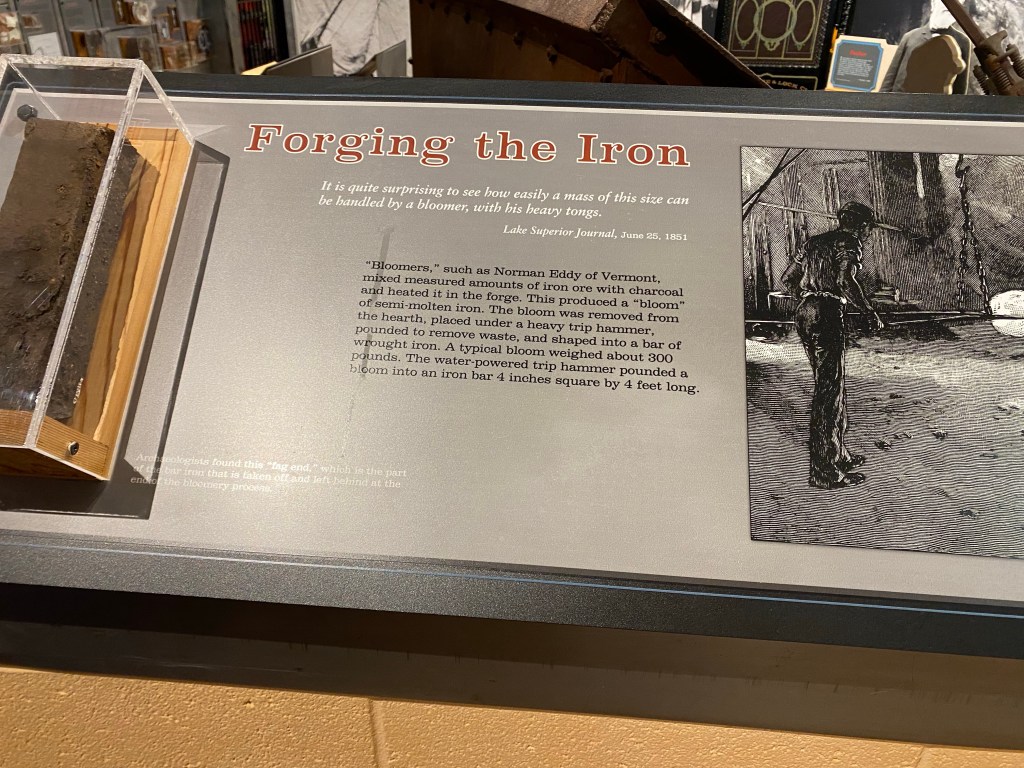
On the last visit I made to my hometown, I visited the Iron Industry Museum. My father and grandfather made their living through this industry. The state of MI and Ford Motor Company were supported for many years through these rich iron ore deposits in the Upper Peninsula.
The words on each exhibit along with the pictures, effectively told the story. Whether the words painted the picture or the picture was worth 1,000 words, I enjoyed the value of communicating this history through word pictures.
In this Psalm, I see an Old Testament word picture or poem. The words were historically recited by the people of Israel on the way to Jerusalem each year (for their three mandatory feast observations).
Rather than trusting man-made idols visible on “the hills” around Jerusalem, the Psalmist called out the truth of God (YHWH) as the creator of heaven and earth.
Even today, we should remember it is not what WE create out of iron or steel that makes us prosper but what God has created in us- a hope and a future.
The Lord “kept” the children of Israel and will “keep” us. What does He keep us from? We are kept from ALL harm when we trust Him.
The harm may include deadly physical elements of heat and sun exposure or nighttime predators. It could also be a spiritual degradation found in today’s culture to remove a life from the earth before their time (aka abortion).
Our coming and going will be kept by God when our eyes look to Him.- Teresa #keeplifesacred
Psalm 121 (ESV) *
A Song of Ascents.
121 I lift up my eyes to the hills. From where does my help come? 2 My help comes from the Lord, who made heaven and earth.
3 He will not let your foot be moved; he who keeps you will not slumber. 4 Behold, he who keeps Israel will neither slumber nor sleep.
5 The Lord is your keeper; the Lord is your shade on your right hand. 6 The sun shall not strike you by day, nor the moon by night.
7 The Lord will keep you from all evil; he will keep your life. 8 The Lord will keep your going out and your coming in from this time forth and forevermore.
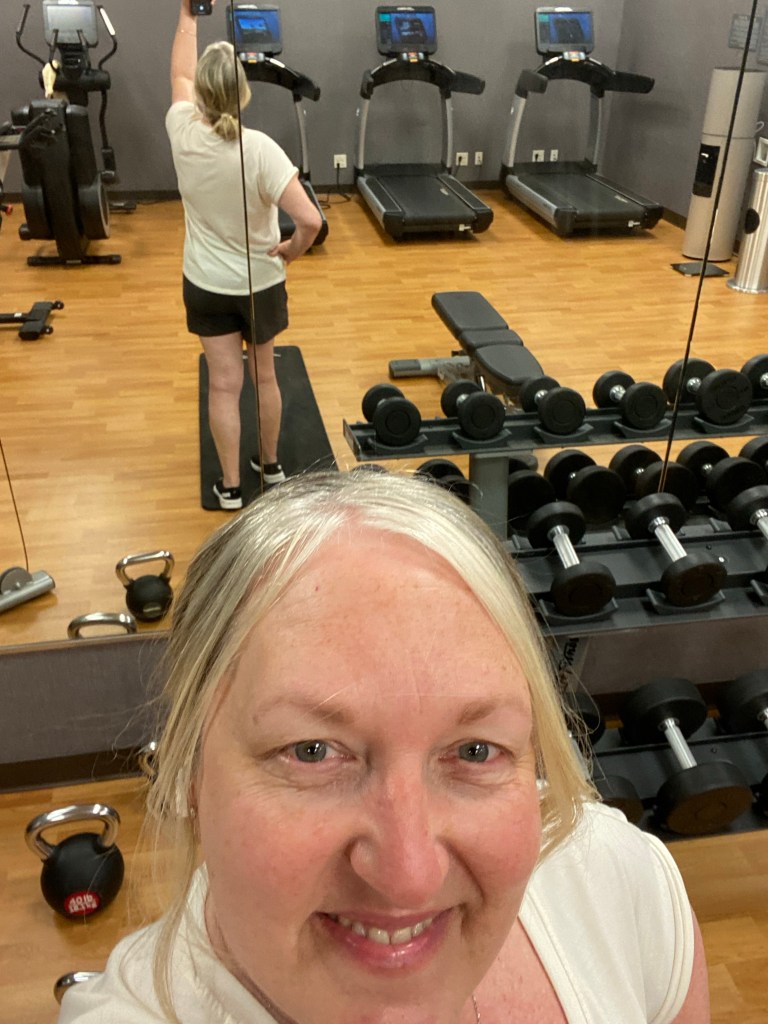
While visiting my mom in MN this week, I grew fond of the elliptical machine for my daily workout. You can see it in the photo on the far left.
Eight years ago, I participated in a program called “Medical Weight Management”. I used their food and sat under the guidance of their dietitians. My weight loss was supervised by a medical doctor. The best thing that I learned throughout the program was to remain committed. We all transitioned from a 1200 cal/day diet to eating the individual number of calories that were allowed (as calculated by a resting metabolic weight test).
The graph that inspired me most in the first 6 months of the program was the steady weight loss as seen on each participants chart. Usually at week 12-15 (or so) many people noted a plateau or even a 5 pound weight gain, while doing the program correctly.
This is the point in the program, where a few people dropped out. They decided that they can do this on their own (less money) because obviously “it’s not working for me”. One such graph was displayed of a member who was on the verge of quitting but then stayed (remained in the program). This particular person dropped another 30 pounds, in addition to the 20 lost prior to their plateau.
What if they just gave up and quit when the graph went up instead of down? Would they have ever seen the joyful ending of hanging in there. They would have failed to get what they were hoping for and had committed to. They would not have remained long enough to see the desired result.
We don’t always see the end of the graph from where we are now standing. That doesn’t mean that a bump in the road will turn us away from our desired destination.
Sure, it’s discouraging, but what’s worse than struggling? I would have to say quitting on yourself is worse than struggling. Wouldn’t you rather continue on and abide in the investment made? #urworthit
In the passage below, John the apostle captures Jesus’ important message to his closest disciples. Jesus knew that there was suffering ahead for all of them. He encourages them to abide in the relationship that had changed their lives and would change the world.
The Father sent his Son to be the Savior of the world. Why? Because He loved the world…he saw us as worthwhile.
Like the early disciples,the fruit that results from God’s love in us (as His sons and daughters) comes from abiding in Christ Jesus. Without Him, we are nothing and with Him we are “home”. Have you ever wanted to belong somewhere safe and beautiful -accepted as you are?
Have I asked the Father in Jesus’ name for the thing I desire most?-Teresa #fullnessofJoy #abide
John 15:1-17 (ESV)*
I Am the True Vine
15 “I am the true vine, and my Father is the vinedresser. 2 Every branch in me that does not bear fruit he takes away, and every branch that does bear fruit he prunes, that it may bear more fruit. 3 Already you are clean because of the word that I have spoken to you. 4 Abide in me, and I in you. As the branch cannot bear fruit by itself, unless it abides in the vine, neither can you, unless you abide in me. 5 I am the vine; you are the branches. Whoever abides in me and I in him, he it is that bears much fruit, for apart from me you can do nothing. 6 If anyone does not abide in me he is thrown away like a branch and withers; and the branches are gathered, thrown into the fire, and burned. 7 If you abide in me, and my words abide in you, ask whatever you wish, and it will be done for you. 8 By this my Father is glorified, that you bear much fruit and so prove to be my disciples. 9 As the Father has loved me, so have I loved you. Abide in my love. 10 If you keep my commandments, you will abide in my love, just as I have kept my Father’s commandments and abide in his love. 11 These things I have spoken to you, that my joy may be in you, and that your joy may be full.
12 “This is my commandment, that you love one another as I have loved you. 13 Greater love has no one than this, that someone lay down his life for his friends. 14 You are my friends if you do what I command you. 15 No longer do I call you servants,[a]for the servant does not know what his master is doing; but I have called you friends, for all that I have heard from my Father I have made known to you. 16 You did not choose me, but I chose you and appointed you that you should go and bear fruit and that your fruit should abide, so that whatever you ask the Father in my name, he may give it to you.17 These things I command you, so that you will love one another.








 Reconnection